


Pest Control in Sugar Land, TX

Sugar Land sits on some of the most expansive clay in the country, and that ground moves every year as it swells in the wet and shrinks in the dry. What it leaves behind is a set of small gaps at the slab edge, the brick veneer and the plumbing penetrations, and pests use every one of them.

We inspect where the ground has opened your house up, then close it.

Get in touch

Pest Control in Sugar Land for Reliable Pest Management

We cover Sugar Land across 77478, 77479 and 77498, taking in First Colony, Sugar Creek, New Territory, Telfair, Riverstone, Greatwood and the Imperial area. Our base is about twenty-five miles north, which puts Sugar Land on a scheduled route rather than an emergency run, and that fits how people here prefer to work with a contractor. Most of our Sugar Land jobs are booked in advance for a specific window rather than same-day. 

The housing here is also fairly consistent, which helps. Sugar Land is dominated by large slab-on-grade homes in master-planned communities built between the 1980s and the 2010s, with high lot coverage, perimeter irrigation and mature tree canopy. Those four things together produce a specific and very predictable set of pest entry points.

Our Services

Roach Control

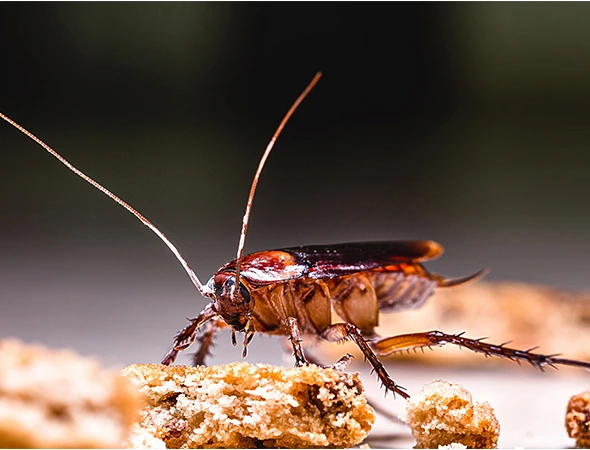
Perimeter irrigation running against a foundation creates a permanently damp band of soil, which is ideal for American cockroaches living in mulch beds, meter boxes and drains. They then use the veneer cracks and weep holes that soil movement has opened. German roaches turn up separately and indoors, and the two need entirely different treatment.

Rodent Control

A mouse fits through a quarter inch and a rat through half an inch, which is exactly the scale of gap that slab movement produces around exterior plumbing penetrations and at door thresholds gone out of square. We identify the species, trap the population, then seal those openings with mortar and metal rather than the foam that gets chewed straight through.

Spider Control

Mature, irrigated landscaping supports a far larger insect population than a new build does, and spiders concentrate wherever their food is. Expect orb weavers across shaded planting and widows in garages, meter boxes and stored patio furniture. We identify what is present, remove webs and egg sacs, and reduce the insect base underneath.

Wildlife Removal

Established communities with canopy, golf course corridors and creek greenbelts give wildlife routes through the neighborhood at roof height. We inspect, remove humanely, seal the entry points and clean up contaminated attic material, and we document the work in writing for association purposes.

Raccoon Removal

Larger homes with real chimneys and mature surrounding trees make attractive raccoon nurseries, particularly between March and June. We check for dependent young before setting anything, remove the family together, then rebuild the soffit and fit a proper stainless chimney cap.

Squirrel Removal

Forty years of tree growth in First Colony and Sugar Creek means canopy sitting at or above roof height across much of the city. Squirrels gnaw soffit seams and fascia gaps to get in. We remove them, rebuild with heavy-gauge metal, and check the attic wiring while we are up there.
How Does Sugar Land Soil Create Pest Problems?

By moving the house. Fort Bend County sits on clay-rich soil, and the Houston Black clay found across this region has a Plasticity Index in the range of 40 to 60, which engineers classify as severely expansive. Anything above 15 counts as expansive and above 30 is considered serious. With roughly 48 to 50 inches of rain a year here, punctuated by heavy storms and occasional multi-month droughts, that clay swells and shrinks through a wide range every year.

The damaging part is that it does not move evenly. One corner of a lot may be saturated while another is bone dry, so parts of a slab are supported and parts are not. The American Society of Civil Engineers has noted that expansive soils cause more financial damage to structures in the United States each year than floods, hurricanes, tornadoes and earthquakes combined. For pest control the relevance is direct. Every season of that movement opens stair-step cracks in brick veneer, gaps around plumbing penetrations, separations at the slab edge and doors that no longer sit square.

How Much Does the Ground Under Sugar Land Actually Move?

Enough to be treated as a structural issue rather than a maintenance one. Houston Black clay, the Texas state soil, is a Vertisol, a soil order named for the way it churns and inverts itself as it cracks and swells. Its Plasticity Index of 40 to 60 puts it firmly in the severely expansive category. Local foundation specialists working Fort Bend County report vertical movement of as much as six inches, and it happens laterally as well as up and down. Landscaping intensifies it in a way that is specific to established neighborhoods like these.

A mature live oak can draw more than 100 gallons of water a day out of the ground, so a large tree on one side of a house dries the clay beneath that side while an irrigated bed on the other keeps its soil saturated. That is differential movement in miniature, happening within a single lot. The visible results are familiar to most Sugar Land homeowners: stair-step cracking in brick, drywall cracks at door corners, tile cracking, and doors that stick in one season and gap in the next. Every one of those is also a gap somewhere in the building envelope.

What Do Foundation Cracks Mean for Pest Entry?

More than most people connect. Homeowners tend to read these signs as a foundation issue to monitor, which they are, but each one also corresponds to a specific opening. Here is how the common symptoms translate into entry points, and what closes each one.

What you notice What it means structurally What it opens for pests What we do about it
Stair-step cracks in brick veneer Differential movement between sections of the slab A direct route into the wall cavity behind the brick Seal at the veneer line and treat the void behind it
Doors that stick, then gap The slab is going out of square seasonally Threshold and frame gaps. A mouse needs a quarter inch Door sweeps, threshold seals, frame gap sealing
Hairline cracks at slab edges Early stage differential movement Small but usable entry at grade for ants and roaches Crack sealing at grade plus perimeter treatment
Gaps at exterior plumbing penetrations The slab shifting against a fixed pipe One of the most common rodent entry routes there is Sealed with mortar and metal, never expanding foam
Patio or driveway pulling away from the slab Uneven settlement of adjoining concrete Sheltered harborage tight against the foundation Fill and treat, then review the drainage feeding it
Weep holes distorted or enlarged Movement in the brick veneer above them Open access into the wall cavity at ground level Weep hole screens that block entry but keep drainage working
A permanently damp band along the wall Perimeter irrigation running against the foundation Ideal harborage for American roaches, and it feeds the movement cycle Adjust irrigation away from the slab and treat the band

Frequently Asked Questions

Yes, and it is how we work in Sugar Land by default. Appointments are booked for a set window rather than a vague half-day, we do not need to make a production of the visit, and we can schedule around the times that suit the household. Where an association needs notice for exterior work, or wants to see what is being done and why, we provide written findings covering the entry points identified and the repairs proposed. Tell us your community when you book and we will format it accordingly.

Contact Us

If you have stair-step cracks in the brick, doors that stick in summer or a gap opening around an outside pipe, those are pest entry points as much as they are foundation signs. Call and book a window that suits you.
You get written findings on every opening we identify and what it takes to close it.

Phone: (832) 538-7583
Email: ajpestcontrolservices26@gmail.com

Send A Message

Areas

Sugar Land is one of ten communities on our list, and we cover three neighboring Fort Bend cities alongside it.

Houston is covered as well. If your address sits between Sugar Land and Missouri City or Richmond, send the zip code and we will confirm which applies.