

Pest Control in Missouri City
A house does not get more sealed as it ages. Every air conditioner replacement, cable run, security camera and dryer vent puts another hole through the outside wall, and after forty or fifty years those add up. Missouri City has a lot of houses that old, which is why rodent work here is really building work.
We audit the whole envelope rather than sealing the one gap you already found.
Get in touch
Rodent Exclusion and Pest Control in Missouri City
We cover Missouri City across 77459, 77489 and the surrounding zip codes, working everything from Quail Valley and Hunters Glen through Lake Olympia and Vicksburg to the newer phases of Sienna and Colony Lakes. Our base is about thirty miles north, so this is a planned visit rather than a same-day dash, which suits the kind of work we do here. Missouri City jobs tend to need a proper walk around the outside of the building rather than a quick treatment, because the entry points are rarely in one place.
The city spans an unusually wide range of housing ages for a single market. Quail Valley opened in 1969 and was largely built out through the 1970s, making it one of the oldest master-planned communities in the whole Houston region, while Sienna has been going up over the last thirty years and is still adding phases. Two houses ten minutes apart can be half a century apart in age, and they need completely different inspections.
Services We Offer
Roach Control
American cockroaches use the same ground-level gaps rodents do, arriving from drains, meter boxes and damp mulch, and older plumbing chases give them easy internal routes. German roaches are a separate indoor problem needing bait and a growth regulator. We confirm the species before quoting because the two plans share almost nothing.

Rodent Control
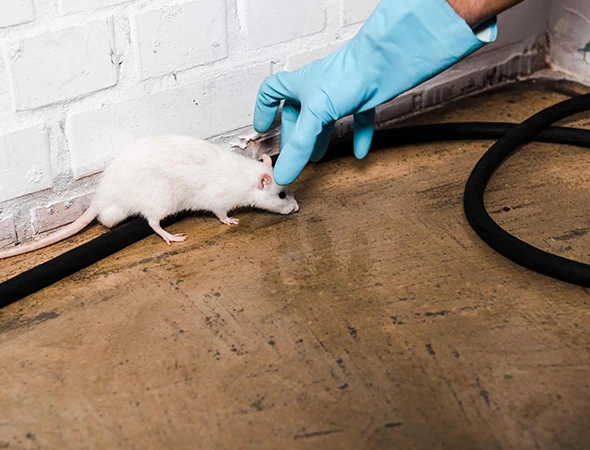
The strongest service in this market and the reason most people call us here. Older homes offer more ways in at ground level, so we identify the species, trap the active population, and then work the full perimeter, meaning weep holes, every utility penetration, the garage door seal, the dryer vent and the soffit line. Sealing is done in hardware cloth, copper mesh, sheet metal and mortar.

Spider Control
Fifty years of landscaping supports a heavy insect population, and spiders concentrate where their food is. Garages, storage areas and the older detached structures common in Quail Valley are where widows turn up most. We identify what is present, clear webs and egg sacs, and reduce the insect base underneath.

Wildlife Removal
Aged soffit, fascia and roof vents give animals openings that a newer home simply does not have, and once weather has softened the timber a small gap becomes a large one quickly. We inspect, remove humanely, rebuild the damaged section and seal it, then clean up the attic material left behind.

Raccoon Removal
Older homes here often have original chimneys without proper caps, which is close to an ideal raccoon nursery between March and June. Mature tree cover across the established sections gives them the route up. We check for dependent young first, remove the family together, then rebuild and cap the access point.

Squirrel Removal
Quail Valley, Hunters Glen and the other older neighborhoods have canopy that reached roof height decades ago, so soffit and fascia gnawing is routine. Older timber gives way faster than new. We remove them, rebuild with heavy-gauge metal rather than patching, and check the attic wiring while we are up there.
Why Do Older Missouri City Homes Get More Rodents?
Because they have more holes, and people added them one at a time without thinking about mice. The median construction year across Missouri City is 1993, so half the housing stock is more than thirty years old, and in Quail Valley homes are typically forty to fifty-five years old. Over that lifespan, a house accumulates penetrations. Air conditioning systems get replaced two or three times, each one drilling a fresh opening for the line set.
Cable, satellite, alarm systems, cameras, water softeners, generators, pool equipment and outdoor kitchens all put pipes and conduit through an exterior wall. Almost none of those trades seal the hole to a standard that stops a mouse, which needs only a quarter inch. Original weep holes were rarely screened when these houses were built, garage door seals have worn flat, and soffit and fascia have had decades of weather. The oldest sections also have a below-ground issue: cast iron sewer lines under 1970s slabs are at or past the end of their service life, and a failed line gives rodents a route in from underneath.
How Old Is the Housing in Missouri City?
Old enough that age is the defining pest factor, though it varies enormously by neighborhood. Census figures put the median construction year across Missouri City at 1993, with around 27,906 housing units and nearly 88 percent of them detached single-family homes. The city holds roughly 78,207 residents and is growing slowly at about 1.14 percent a year, and the median age of 40.5 is the highest of any area we serve, which typically means longer tenure and homes that have been lived in and modified rather than recently built and sold.
At one end sits Quail Valley, developed from 1969 by James MacNaughton around a golf course, largely finished by the end of the 1970s, and now covering roughly 4,372 houses across fifteen subdivisions with several separate homeowner associations. Foundation specialists working this market describe homes there as forty to fifty-five years old with cast iron plumbing beneath the slab at or past the end of its service life.
Where Do All the Extra Holes in an Older House Come From?
From tradespeople, over decades, one job at a time. None of them did anything wrong. Sealing a penetration against rodents is simply not part of most installations, and the material used is rarely chosen to last. Here is what we find most often on Missouri City homes and who, realistically, closes it properly.
| What was installed | Where it goes through | What it usually leaves behind | Who normally seals it |
|---|---|---|---|
| AC replacement, line set | Exterior wall beside the unit | An oversized hole with foam that has since crumbled in the sun | Rarely anyone. This is the most common rodent entry we find |
| Cable, internet or satellite | Wall or soffit | A small drilled hole, often left completely open | Almost never |
| Alarm system or cameras | Soffit and eaves, several points | Multiple small holes across the roofline | No |
| Dryer vent replacement | Exterior wall | A gap around the duct and a missing or stuck flapper | Frequently left open |
| Water softener or filtration | Garage wall or through the slab | A pipe penetration wider than the pipe | Sometimes, and usually with foam |
| Generator or EV charger | Exterior wall through to the panel | Conduit sealed at the conduit, not at the wall | Partially |
| Pool equipment | Slab and rear wall | Bonding wire and plumbing runs through the envelope | Rarely |
| Outdoor kitchen gas line | Rear wall or slab edge | A pipe penetration left open at the wall face | Sometimes |
Frequently Asked Questions
Not at all, and older homes usually respond very well because the openings are findable rather than mysterious. The work is more thorough than on a newer property, since we are checking decades of accumulated penetrations rather than a handful of original ones, so allow more time for the inspection. Materials matter more here too, because timber that has weathered for fifty years will not hold a screw the way new fascia does, so repairs sometimes need rebuilding rather than just covering.
Very possibly, and it is one of the most common patterns we see. Replacing a condenser or air handler usually means a new hole through the exterior wall for the line set, and it is normally filled with expanding foam if it is filled at all. Foam is not a rodent barrier, it degrades in sunlight, and mice chew through it easily. If the timing lines up with a recent installation, that penetration is the first place we look.
Yes, and it is more likely in the older parts of Missouri City than almost anywhere else we work. Rats travel sewer lines routinely, and cast iron drain lines under 1970s slabs are now at or beyond their service life, so cracks and collapses create openings between the sewer system and the void under your floor. If you are seeing rodents with no findable entry point above ground, this is worth ruling out. Diagnosing it needs a plumber with a camera rather than a pest control company, and we will tell you that plainly rather than keep looking.
A significant one, and the two really are different jobs. A recent Sienna home has a tight envelope with only its original penetrations, so the work is usually a quick perimeter check and sealing anything the builder left. A Quail Valley home of the same size may have twenty or more penetrations added over fifty years, aged soffit and fascia, unscreened weep holes and a worn garage door seal. Same city, same pests, roughly twice the inspection.
Usually one of two things, and often both. The first is materials, because expanding foam, caulk, plastic vent covers and steel wool on its own are all chewed through or worked loose within weeks, so the repair fails rather than the plan. The second is coverage, because sealing the opening you found does nothing if there are five more you did not. On an older home the entry points are almost always plural. We work the full perimeter and roofline and seal in hardware cloth, copper mesh, sheet metal and mortar.
Contact Us
Trapping alone will not finish it, because the way in is still open and there is usually more than one. Call and tell us the age of the house and roughly what work has been done to it over the years, because that tells us where to look before we arrive.
You get a full perimeter and roofline audit, and every opening we seal is closed in metal and mortar rather than foam.
Phone: (832) 538-7583
Email: ajpestcontrolservices26@gmail.com
Send A Message
Areas
We do. Missouri City sits alongside Sugar Land and Stafford, and we cover all three plus seven more communities across Fort Bend, Harris and Montgomery counties.
Houston is covered as well, including the Harris County portion of Missouri City. Send us your zip code if you are unsure which page applies.