

Pest Control in The Woodlands, TX
The Woodlands was built inside a working forest on purpose, and the covenants that protect that forest also mean you usually cannot remove the tree touching your roof. Squirrels and raccoons take full advantage of it, which is why this is the heaviest wildlife market we serve.
So we work on the part you do control, which is the building itself.
Get in touch
Wildlife Removal and Pest Control in The Woodlands
We cover the whole of The Woodlands, across all the villages from Grogan’s Mill and Panther Creek through Cochran’s Crossing, Alden Bridge and Sterling Ridge to Creekside Park on the Harris County side. Our base is roughly twenty-five miles southwest, so this is a scheduled route rather than an emergency dash, and that suits the work here. Woodlands jobs tend to be attic and roofline jobs, and they benefit from a proper inspection and a planned return rather than a rushed visit.
The community is also unusual in how it is run. There is no city government, because residents have voted against incorporation, and The Woodlands Township operates instead as a special district funded through property taxes and assessments rather than conventional HOA dues. Practically, that means most exterior work on your home goes through a design review process, and we write up our findings in a form you can actually submit.
Our Services
Roach Control
The smokybrown cockroach is the species that matters most in this community, because it lives in tree holes, gutters and leaf litter and comes in through attic vents and rooflines rather than drains. Dense canopy means constant leaf litter and loaded gutters. Treating a kitchen for a smokybrown problem accomplishes nothing.

Rodent Control
Roof rats rather than Norway rats dominate here, for the same reason squirrels do. They are arboreal, travel branches, fence lines and utility cables, and enter at roof level, so trapping has to happen at height on confirmed runways. We trap, then seal the roofline with materials they cannot gnaw through.

Spider Control
Mature forest supports a large insect population, and spiders concentrate wherever their food is. Expect orb weavers across shaded outdoor spaces and wolf spiders at ground level, with widows in garages, meter boxes and stored patio furniture. We identify what you have, remove webs and egg sacs, and reduce the insect base underneath.

Wildlife Removal
The full process on anything living in the structure, which here almost always means roof-level entry. Inspection, humane removal, exclusion, damage assessment and attic sanitation are handled as one job, and we document the entry points and repairs in writing for design review purposes.

Raccoon Removal
Heavy canopy plus larger, older homes with real chimneys makes this prime raccoon territory, particularly for females looking for a nursery between March and June. We check for kits before setting anything, remove the family together, then rebuild the soffit and fit a proper stainless chimney cap rather than laying mesh over the flue.

Squirrel Removal
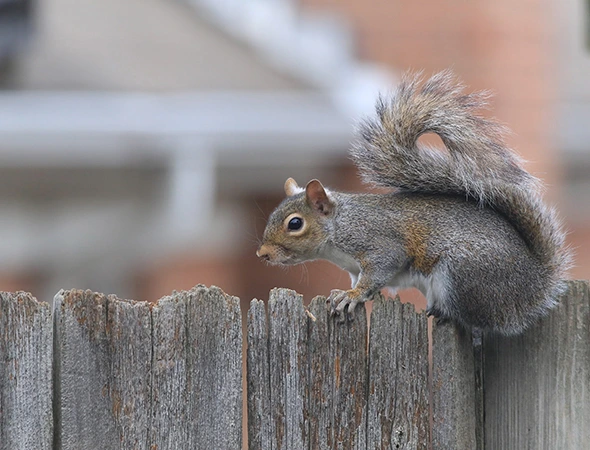
Our single busiest service in this community, and the one the forest design guarantees. Squirrels gnaw soffit seams, fascia gaps and gable vents, and they breed twice a year here so pressure arrives in two waves. Since the tree usually cannot come down, we rebuild the damage in heavy gauge metal, seal the roofline properly and check the attic wiring.
Why Is Attic Wildlife So Common in The Woodlands?
Because the forest is not next to the neighborhood, it is inside it, and that was the plan from the start. George Mitchell opened The Woodlands in October 1974 with the explicit goal of preserving at least 28 percent of the native pine forest, and today around 7,665 of the community’s roughly 28,800 acres are green space in the form of parks, greenbelts, golf courses and forest preserve.
Then the covenants close off the obvious response. Under the Township standards, no tree greater than six inches in diameter, measured two feet above ground, may be removed without approval from the Plan Review Committees, and removal comes with a permit, an inspection and a replanting requirement. So the homeowner who works out that a specific pine is the access route usually cannot simply take it down. With clearance largely unavailable, sealing the structure is not the better option here, it is the only one that works.
How Much of The Woodlands Is Actually Forest?
Roughly a quarter of it, permanently. Of the approximately 28,800 acres that make up The Woodlands, about 7,665 acres are green space in parks, greenbelts, golf courses and preserve, and Mitchell’s founding target was to keep at least 28 percent of the native pine forest standing. The community now holds more than 118,000 residents and around 27.9 billion dollars of real estate development, which makes it one of the largest and most valuable master-planned communities in the country.
Governance is worth understanding too, because it affects what you can do to your own property. The Woodlands Township was formed in 2007 and took over full community association services in 2010, and residents have voted down proposals to incorporate as a city, most recently in November 2021. Each developed village has its own Residential Design Review Committee made up of elected resident volunteers, a separate Development Standards Committee handles variances, and individual villages have their own Neighborhood Criteria on top of the community-wide standards.
What Can I Legally Do About the Tree Squirrels Are Using?
Less than you might hope, and that is the honest answer. The covenant protects the tree, not the roofline. Here is what each option actually involves and how much it does for a wildlife problem, so you can spend money on the thing that works rather than the thing that feels obvious.
| Option | Covenant position | Effect on wildlife access | Practical note |
|---|---|---|---|
| Remove a tree over 6 inches diameter | Plan Review Committee approval, permit, inspection and replanting required | Removes one route, not all of them | Rarely approved for wildlife reasons alone. Appeals need a certified arborist statement |
| Remove a tree under 6 inches | Generally below the permit threshold, but check your village criteria | Minimal. Small trees are seldom the access route | Worth doing only where it is a genuine bridge to the roof |
| Selective limb trimming or crown reduction | Usually permitted where removal is not. Village criteria still apply | Meaningful, especially limbs sitting above the roof | The most realistic clearance option available here |
| Emergency removal after storm damage | Approval may not be needed, but verify afterward | Situational | Photograph the damage before any work is done |
| Roofline, soffit and vent sealing | No tree covenant involvement at all | High. This is what actually stops entry | Entirely within your control. No committee, no waiting |
| Chimney cap, downspout and line guards | Exterior alterations may need design review. Line guards involve the utility | High for that specific route | We supply written findings you can attach to a submission |
Frequently Asked Questions
Usually not without going through the Township first. Any tree over six inches in diameter, measured two feet above ground, needs Plan Review Committee approval to remove, and that comes with a permit, an inspection and a replanting requirement. Wildlife access on its own is not a strong basis for approval, and appeals generally require written support from a certified arborist. Selective limb trimming is often allowed where full removal is not, so that is usually the realistic route, alongside sealing the building.
Possibly, and it depends on how visible it is and which village you are in. Exterior alterations to a home in The Woodlands generally fall under design review, and standards vary by village under the Neighborhood Criteria. In practice, a properly fitted chimney cap and screening behind a soffit or gable vent tend to be straightforward because they match the existing structure. We give you written findings identifying the entry point and the repair proposed, which is what a Residential Design Review Committee submission needs, and we will tell you honestly if something we recommend is likely to require approval.
Yes, but the honest framing is containment rather than removal. Around 7,665 acres of The Woodlands is permanent green space, so if you back onto it the animal population on the other side of your fence is not going anywhere, this year or in twenty years. What is achievable is making your house a closed structure. That means every soffit seam, fascia gap, gable and ridge vent, chimney and utility penetration sealed in materials that cannot be gnawed or pulled apart. Properties that get that work done properly stay clear despite the preserve.
It matters for approvals rather than for the pests. Each developed village has its own Residential Design Review Committee of elected resident volunteers, and villages carry their own Neighborhood Criteria in addition to the community-wide standards, so what is permitted on an exterior alteration can differ between Sterling Ridge and Grogan’s Mill. There is also a jurisdictional split, since Creekside Park sits in Harris County while the rest of The Woodlands is in Montgomery County. Tell us your village when you book and we will format our documentation accordingly.
No, and we would rather say so plainly than take the booking. Deer are not a structural pest problem and they are not something a pest control license covers. Managing deer in The Woodlands is a community and wildlife authority matter, so the Township is the right first call, and Texas Parks and Wildlife governs the wider rules. What we can help with is everything that gets into the building itself, meaning squirrels, raccoons, roof rats, roaches and spiders. If deer damage to your landscaping is drawing other pests, such as fallen fruit attracting rodents, that part we can address.
Contact Us
The tree probably has to stay, and that is fine, because the roofline is what decides whether anything gets inside. Call and tell us which village you are in and what you are hearing, and we will book a full roofline and attic inspection.
You get written findings covering entry points, damage and the repairs proposed, in a form you can submit for design review.
Phone: (832) 538-7583
Email: ajpestcontrolservices26@gmail.com
Send A Message
Areas
We do. The Woodlands is one of ten communities we serve from our northwest Houston base, across Montgomery, Harris and Fort Bend counties.
Houston is covered as well. If your address sits on the boundary between The Woodlands and Spring or Conroe, send the zip code and we will confirm which applies.